
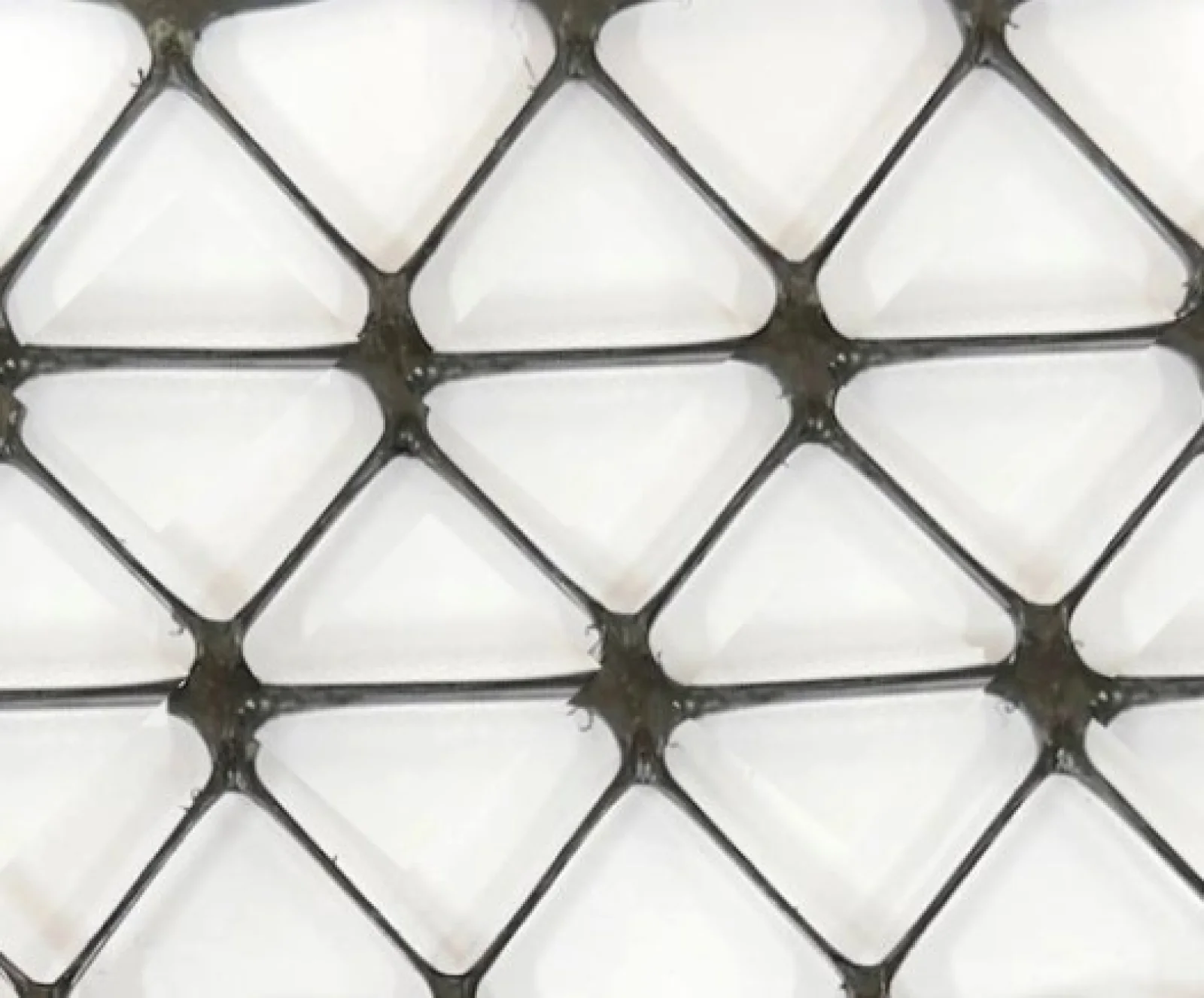
TechGrid Three Axes Geogrid is an integrally formed polypropylene geogrid with a three-directional triangular structure. Manufactured through a precision punching-and-drawing process, it is designed to provide reinforcement and load transfer in multiple directions. Its grid geometry is intended to promote aggregate interlock and soil confinement, helping manage deformation in engineered ground systems.
The product is intended for pavement stabilization, ground improvement, embankment reinforcement, and support beneath selected foundations. Its contribution to performance depends on subgrade and aggregate properties, loading, installation, product characteristics, and the overall engineering design. Consult the current technical data sheet to confirm suitability for a specific project.
Features
Solutions
Success Stories
Resources
Multidirectional load transfer
The three-directional triangular geometry is designed to distribute loads in multiple directions within a properly designed reinforced layer.
Soil and aggregate confinement
The grid structure can interact with surrounding aggregate and help limit lateral movement under loading.
Stiffness and junction integrity
The source identifies high stiffness and integral junction strength as product characteristics. Verify specific performance values in the current technical data sheet.
Subgrade stress management
By helping distribute loads within the reinforced layer, the product is designed to reduce localized stress concentration on weak subgrades.
Pavement stabilization
The source identifies roads, industrial pavements, and haul roads as application areas.
UV stabilization and chemical resistance
The source describes the polypropylene geogrid as UV-stabilized and chemically resistant. Confirm applicable exposure limits and product-specific documentation.
Potential reduction in deformation
The geogrid may help manage rutting and deformation when correctly selected and installed. Actual performance depends on project conditions and design.
TechGrid Three Axes Geogrid is placed within a designed granular or soil layer. Its triangular geometry creates a multidirectional grid structure that can interact with surrounding aggregate, helping confine the material and resist lateral movement under repeated loading.
The source describes the grid as providing load transfer and reinforcement in all directions, with high stiffness and junction integrity. These characteristics are intended to help distribute loads and manage stress concentrations over weak ground. Actual benefits depend on the product grade, subgrade conditions, aggregate properties, loading, construction quality, and engineering design.
Innovative multidirectional reinforcement solutions for superior ground stabilization, load distribution, and long-term infrastructure performance.
TechGrid Three Axes Geogrid can be incorporated into pavement structures where multidirectional reinforcement and aggregate confinement are required. When designed for the site conditions, it may help distribute traffic loads and manage rutting over weaker subgrades.
Applications
For weak or variable ground, the geogrid may be included within an engineered granular layer to help confine the material and manage deformation. Suitability depends on the subgrade, expected loads, drainage, aggregate properties, and construction method.
Applications
The product is listed for embankment reinforcement. It may be considered where the design requires load distribution and stabilization within an embankment or related earth structure. The reinforcement layout and product properties must be verified through project-specific design.
Applications
The source identifies foundation support as an application, including shallow foundations and storage tank foundations. The geogrid may be considered as part of a designed ground improvement system where localized stress concentration or weak subgrade conditions are a concern. Foundation performance must be established by geotechnical design rather than assumed from the product alone.
Applications
 European Conformity (CE)
 ISO 9001

Provide the current installation guidance for road applications, including placement, overlaps, aggregate placement, compaction, and any product-specific handling requirements.
Link to the current road installation guide or other relevant installation videos available from Techfab USA. Confirm that the content matches the product and application before publishing.
Connect with our engineering team for expert guidance
TechGrid Three Axes Geogrid is an integrally formed polypropylene geogrid with a three-directional triangular structure. It is manufactured through a punching-and-drawing process and is designed to provide multidirectional reinforcement and load transfer in ground stabilization applications.
The term refers to the product’s three-directional triangular grid geometry. The source describes this structure as helping distribute loads and provide reinforcement in multiple directions, rather than relying on only one principal reinforcement direction.
The source identifies the product as an integrally formed polypropylene geogrid. It also describes the material as UV-stabilized and chemically resistant. Confirm relevant product specifications and exposure limits in the current technical data sheet.
The grid geometry can interact with surrounding aggregate to create confinement and resist lateral movement. This interaction may help the reinforced layer distribute loads under traffic or equipment loading, depending on aggregate properties and the overall design.
The source lists pavement stabilization, ground stabilization, embankment reinforcement, and foundation support. Examples include roads and highways, industrial pavements, haul roads, working platforms, access roads, logistics and container yards, embankments, shallow foundations, and storage tank foundations.
Weak-subgrade stabilization is one of the stated application areas. The geogrid may help confine the overlying granular layer and manage load distribution when included in a properly designed system. The design must still account for subgrade strength, drainage, loads, aggregate, and construction methods.
The source states that the product is intended to reduce rutting and improve pavement stability. Actual results depend on pavement structure, subgrade, aggregate, traffic loading, installation, and project design; no fixed reduction should be assumed without supporting evidence.
Working platforms and construction access roads are listed applications. Product selection and platform design should consider bearing conditions, equipment loads, subgrade strength, drainage, aggregate, and construction requirements.
Road and railway embankments are included in the source application list. Suitability depends on embankment design, ground conditions, expected loads, settlement criteria, and the product’s verified properties.
Shallow foundations and storage tank foundations are listed applications in the source material. These are design-sensitive uses, so a geotechnical engineer should evaluate the soil profile, loading, settlement criteria, foundation layout, and verified product properties.
Junction integrity refers to the performance of the integral connections within the geogrid structure. The source identifies strong junction integrity as a product feature. For engineering selection, refer to product-specific test results and applicable design criteria.
The source describes it as UV-stabilized and chemically resistant. Confirm product-specific evidence, exposure limits, and relevant installation or service conditions before relying on these properties.
Useful information includes the intended application, subgrade and aggregate properties, loading, pavement or foundation design, expected deformation, drainage conditions, construction method, and project specifications. Confirm required stiffness, junction, tensile, and durability properties against the current technical data sheet.
Refer to the current TechGrid Three Axes Geogrid technical data sheet, product brochure, and approved installation guidance provided by Techfab USA. Make sure the documentation matches the product being specified.