
Improvement of Road from SH to Kandalgaon Road ODR - 90Km 0/000 to 4/300, Tal - Karveer, Dist - Kolhapur, Maharashtra

Kolhapur, Maharashtra, India | PMGSY, Maharashtra Rural Road Development Association (MRRDA) Kolhapur

Overview

The road from the State Highway (SH) to Kandalgaon (ODR-90 km, chainage 0/000 to 4/300) in Taluka Karveer, District Kolhapur traverses terrain dominated by black cotton (BC) soil with a very low CBR value. The alignment is flanked by irrigated agricultural fields and features multiple cross-drainage structures and ponds, leading to localized erosion and water accumulation.

Due to its connectivity to a State Highway, the road experiences high vehicular traffic intensity. With the onset of the monsoon, the stretch becomes heavily waterlogged, and the combination of weak BC subgrade, moisture ingress, and heavy traffic has caused significant distress, including settlements, unevenness, and fatigue cracking.

Challenge

The underlying black cotton soil contains montmorillonite clay minerals, which exhibit problematic behavior:

  • Becomes soft and slushy when wet
  • Turns brittle and cracked when dry
  • Undergoes repeated swelling–shrinkage cycles, leading to loss of strength and pavement support

Designing a conventional flexible pavement over such soil would require an excessively thick crust, making the project uneconomical and material-intensive while still risking long-term performance issues.

Solution

TechFab recommended TFI-5300 Type-I, a polypropylene woven geotextile, for subgrade stabilization of the distressed BC soil stretches.

Key characteristics of TFI-5300 Type-I:

  • Constructed with slit-film (tape) yarns in the warp and fibrillated tape yarns in the weft for high tensile strength and stability
  • UV-stabilized to resist degradation from sunlight exposure
  • Chemically resistant to common soil chemicals, mildew, and insects
  • Non-biodegradable, ensuring long-term performance in aggressive soil environments

Function in the pavement:

  • Provides separation between soft BC subgrade and granular WBM layers
  • Delivers tensile reinforcement to distribute wheel loads over a wider area
  • Reduces punching shear failure, rutting, and differential settlement
  • Enhances drainage functionality while preventing fine soil migration into the base

The road was opened to traffic immediately after completion of the WBM layer. Observations over the following one month showed no visible settlement, indicating effective stabilization even under early traffic and residual moisture conditions.

Project Outcome & Performance

  • Successful rehabilitation of a 4.3 km high-traffic rural road over problematic black cotton soil
  • No post-construction settlement observed during initial monitoring period
  • Improved ride quality and structural integrity under monsoon-influenced conditions
  • Enhanced durability with reduced risk of recurrent distress and maintenance
Related Sectors
Related Solutions

Frequently Asked Questions
(FAQs)

It is a 4.3 km rural road upgradation (ODR-90 km, Ch. 0/000 to 4/300) in Taluka Karveer, District Kolhapur, Maharashtra, executed under PMGSY for the Maharashtra Rural Road Development Association (MRRDA), Kolhapur. The road connects a State Highway (SH) to Kandalgaon and passes through black cotton (BC) soil with very low CBR, high traffic intensity, and monsoon-induced waterlogging.

The road suffered from:

  • Very weak subgrade (black cotton soil with low CBR)
  • Heavy vehicular traffic due to SH connectivity
  • Waterlogging during monsoons from adjacent irrigated fields, ponds, and cross-drainage structures
  • Resulting distress: settlements, unevenness, fatigue cracking, and rapid deterioration of the WBM layer

Black cotton soil contains montmorillonite clay minerals, which cause:

  • Soft, slushy behavior when wet → loss of bearing capacity
  • Brittle, cracked condition when dry → shrinkage and surface distress
  • Repeated swelling–shrinkage cycles → volume changes that break pavement layers
  • Conventional flexible pavements over BC soil require very thick granular crusts, making them uneconomical and still prone to failure

TechFab recommended TFI-5300 Type-I, a polypropylene woven geotextile, for subgrade stabilization.

Key features:

  • Slit-film (tape) yarns in warp + fibrillated tape yarns in weft → high tensile strength and dimensional stability
  • UV-stabilized for resistance to sunlight degradation
  • Chemically resistant to soil chemicals, mildew, and insects
  • Non-biodegradable for long-term performance
  • Separation: Prevents soft BC soil from mixing with granular WBM layers
  • Reinforcement: Distributes wheel loads over a wider area, reducing stress on the weak subgrade
  • Deformation control: Limits punching shear, rutting, and differential settlement
  • Drainage support: Allows water to pass while retaining fines, reducing pore pressure buildup

Yes. The road was opened to traffic right after completion of the WBM layer. Monitoring over the next one month showed no visible settlement, confirming effective stabilization even under early traffic loading and residual moisture conditions.
  • Successful rehabilitation of a high-traffic rural road over problematic black cotton soil
  • No post-construction settlement observed during the initial monitoring period
  • Improved ride quality, structural integrity, and monsoon resilience
  • Reduced risk of recurrent distress and frequent maintenance
  • TechFab Metal Gabion – likely used for associated drainage, erosion control, or cross-drainage protection works
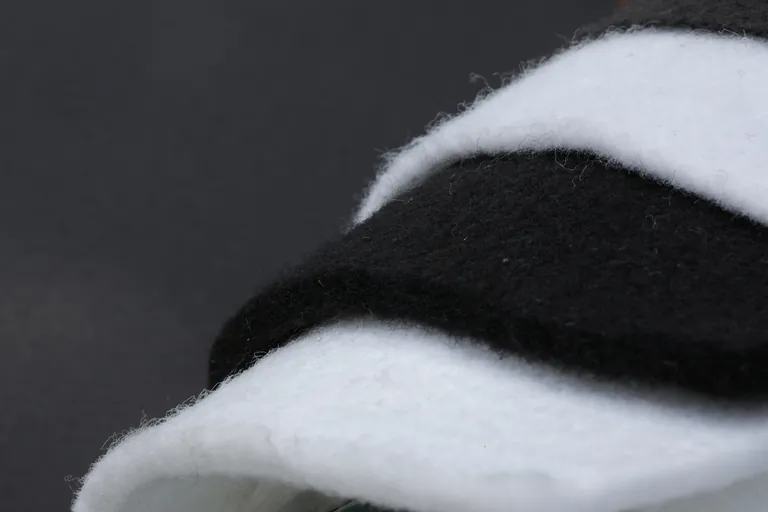
  • TechGeo PP Woven Geotextile – potentially used for filtration/separation in drainage layers or alongside gabion structures