Home / Success Stories / Construction of Embankment using TFI 5200 Tape Woven Geotextile
NH-17, Calicut, Kerala, India | National Highways Authority of India (NHAI)
As part of the Calicut Bypass Phase III initiative—funded by the Ministry of Road Transport & Highways and executed by the Public Works Department (National Highways), Kerala—a 3-kilometer-long road embankment was required, with heights reaching up to 5 meters. The construction site presented extremely challenging ground conditions, consisting of old paddy fields and marshy land with very soft subgrade.
To address the complex engineering problems associated with building embankments on such soft foundations, TechFab Woven Geotextile was deployed as a key component of the ground improvement strategy.
The soft clay deposits at the site ranged in thickness from 3 to 8 meters, raising significant concerns about embankment stability and post-construction settlements. Compounding the difficulty, the uppermost clay layer was exceptionally soft with very high water content, making it impossible to conduct normal construction operations directly on this stratum.
Removing this soft clay layer was not a practical option for several reasons:
Given these constraints, innovative engineering techniques were needed to deliver a satisfactory and cost-effective solution.
A two-pronged approach was adopted to address the ground improvement challenges:
1. Pre-fabricated Vertical Drains (PVDs)
Pre-fabricated Vertical Drains were installed throughout the soft clay zone to accelerate consolidation. As the clay consolidated under the applied load, its shear strength increased correspondingly, ensuring adequate embankment stability. This approach also ensured that the majority of settlements occurred before pavement construction, minimizing post-construction deformation.
2. Woven Geotextile Reinforcement
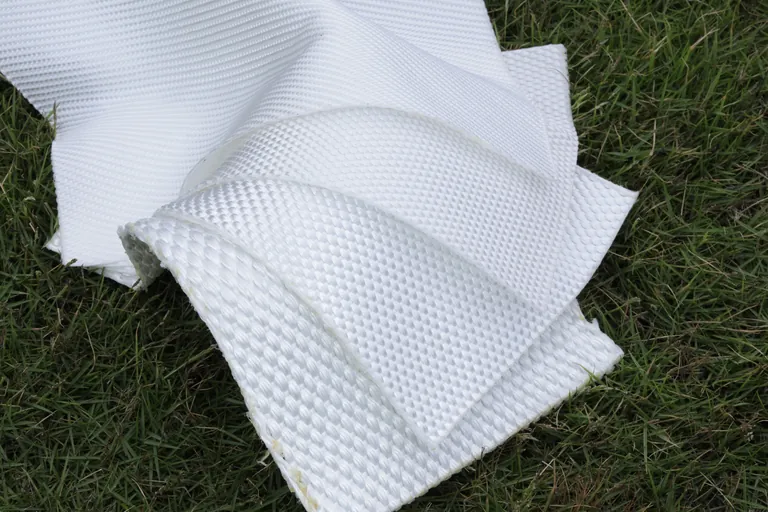
As an alternative to excavating and removing the extremely soft top clay layer, a woven geotextile was employed to stabilize the subgrade. Following a thorough evaluation of required geotextile functions and properties, TechFab TPP 250—a woven polypropylene tape geotextile manufactured by TechFab — was selected for this application.
The geotextile possessed a combination of mechanical and hydraulic characteristics that made it well-suited to function as both a separator and reinforcement layer. Additionally, its 5-meter width minimized the need for overlaps during installation.
Key Functions of Techfab TPP 250 Woven Geotextile
When installed at the subgrade surface, the geotextile performed multiple critical functions:
The deployment of TechFab TPP 250 Woven Geotextile delivered an environmentally friendly solution that eliminated the need for large-scale excavation and disposal of soft clay. The project was completed successfully, achieving appreciable savings in both cost and construction time compared to conventional approaches.
The Calicut Bypass Phase III is a highway infrastructure project funded by the Ministry of Road Transport & Highways and executed by the Public Works Department (National Highways), Kerala. It includes the construction of a 3-kilometer-long road embankment with heights up to 5 meters.
The site consisted of old paddy fields and marshy land with very soft subgrade conditions, presenting extremely challenging ground conditions for embankment construction.
The primary challenges included:
Excavation and removal were not practical for three main reasons:
Innovative engineering techniques were adopted to deliver a satisfactory and cost-effective solution without the need for large-scale excavation.
A two-pronged approach was adopted:
PVDs are drainage elements installed throughout the soft clay zone to accelerate consolidation. They provide vertical drainage paths that allow pore water to escape more quickly under applied loads, speeding up the consolidation process.
As the clay consolidated under the applied load, its shear strength increased correspondingly, ensuring adequate embankment stability. Additionally, this approach ensured that the majority of settlements occurred before pavement construction, minimizing post-construction deformation.
This geotextile possessed a combination of mechanical and hydraulic characteristics that made it well-suited to function as both a separator and reinforcement layer. Its 5-meter width also minimized the need for overlaps during installation.
The geotextile performed three critical functions:
The key outcomes included:
Compared to conventional excavation and removal methods, this geotextile-reinforced approach achieved appreciable savings in both cost and construction time while delivering an environmentally friendly solution.
The solution eliminated the need for large-scale excavation and disposal of soft clay, avoiding the environmental challenges associated with transporting and disposing of large volumes of excavated material.
This approach demonstrates that woven geotextiles can effectively stabilize extremely soft subgrades, offering a cost-effective, time-efficient, and environmentally friendly alternative to traditional excavation methods for embankment construction on challenging ground conditions.
TechGeo PP Woven Geotextiles were used, specifically the Techfab TPP 250 Woven Polypropylene Tape Geotextile.