Ground Improvement Solution using TGC Reinforcement Geotextile for Construction of Retaining Wall at Indonesia

Indonesia

Overview

A new road was planned in Kalimantan, Indonesia to improve intra-city accessibility and reduce congestion on main urban roads. TechFab supplied the geosynthetic products required for ground improvement associated with this road and retaining wall project.

Challenge

To maintain the desired road level, an RCC retaining wall with crash barrier was proposed along one side of the road. However, local geological conditions in Indonesia made it difficult to source adequate frictional (granular) backfill soil. Importing or procuring sufficient quantities of such soil would have significantly increased project cost.

The available backfill material had poor gradation with high clay/fines content, raising concerns about:

  • Uneven settlement and surface deformations at the road level
  • Excess pore water pressure buildup behind the wall
  • Potential long-term instability of the retaining structure and supported road

Ground improvement was therefore essential to enhance drainage, reinforce the base, and mitigate settlement risks.

Solution

The retaining wall design was carried out in accordance with BS 8006 and FHWA-NHI-00-043 guidelines, including checks for external, internal, and global stability under both static and seismic conditions.

Given the poor soil conditions, a composite geotextile capable of performing multiple functions was recommended:

  • Separation: Prevents intermixing of backfill and foundation soils, allowing a significant reduction in the volume of imported frictional soil
  • Filtration & Drainage: Facilitates dissipation of pore water pressure, reducing hydrostatic buildup behind the wall
  • Reinforcement: Provides tensile strength to limit uneven settlement and deformations at the road surface

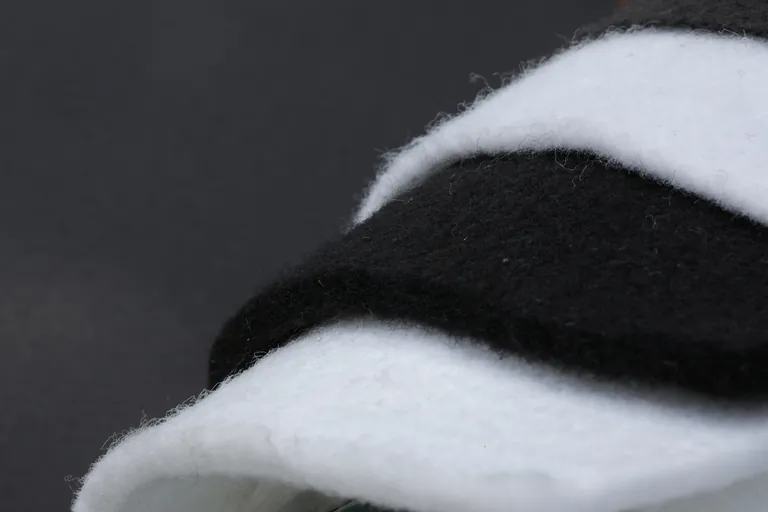
Accordingly, TGC 110/15 Reinforcing Geotextile was supplied for ground improvement. This composite product integrates the required separation, filtration, drainage, and reinforcement functions in a single layer, simplifying construction and improving overall performance.

Project Outcome & Performance

The use of TGC reinforcing geotextile enabled:

  • Reduced dependency on scarce, costly frictional backfill material
  • Improved drainage and pore pressure dissipation behind the retaining wall
  • Enhanced stability and reduced risk of differential settlement and surface deformation
  • A more economical and constructible solution for the retaining wall and associated road
Related Sectors
Related Solutions

Frequently Asked Questions
(FAQs)

It is a ground improvement and retaining wall project for a new city road in Kalimantan, Indonesia, aimed at improving intra-city accessibility and decongesting main urban roads. TechFab supplied the geosynthetic products used for base reinforcement and drainage behind an RCC retaining wall.

To maintain the desired road elevation and alignment, an RCC retaining wall with crash barrier was proposed along one side of the road. The wall was needed to:

  • Support the road embankment and maintain grade
  • Provide a stable edge for the carriageway in constrained urban terrain
  • Ensure long-term stability of the road structure
  • Local soils had poor gradation with high clay/fines content, making them unsuitable as frictional backfill
  • Sourcing or importing adequate granular (frictional) backfill would have been very expensive
  • Risks included:
  • Uneven settlement and surface deformations at road level
  • Excess pore water pressure buildup behind the wall
  • Potential long-term instability of the retaining structure and supported pavement

Ground improvement was essential to:

  • Enhance drainage and dissipate pore water pressure behind the wall
  • Provide tensile reinforcement to the backfill and base layers
  • Reduce differential settlement and surface deformations
  • Allow use of locally available soils with reduced dependence on imported granular fill

The retaining wall was designed in accordance with:

  • BS 8006 (Code of practice for strengthened/reinforced soils)
  • FHWA-NHI-00-043 (Design guidelines for mechanically stabilized earth walls)

Design checks included:

  • External stability (sliding, overturning, bearing capacity)
  • Internal stability (reinforcement strength, pullout, rupture)
  • Global stability (overall slope/embankment stability)
  • Consideration of both static and seismic loading conditions

A composite reinforcing geotextile, TGC 110/15, was used to provide multiple functions in a single layer:

  • Separation: Prevents intermixing of backfill and foundation soils, reducing the required volume of imported frictional soil
  • Filtration & Drainage: Allows water to pass while retaining fines, facilitating rapid dissipation of pore water pressure
  • Reinforcement: Provides tensile strength to limit uneven settlement and deformations at the road surface

Compared to using poor-quality local soil alone, TGC 110/15:

  • Reduces reliance on costly, scarce granular backfill
  • Improves drainage, lowering hydrostatic pressure behind the wall
  • Enhances overall stability and load distribution
  • Limits differential settlement and surface cracking/deformation
  • Simplifies construction by combining several functions in one product
  • Cost savings: Lower quantity of imported frictional soil required
  • Improved drainage: Faster pore pressure dissipation behind the retaining wall
  • Enhanced stability: Better performance under static and seismic conditions
  • Reduced deformations: Lower risk of uneven settlement and road surface distress
  • Constructability: Easier and faster installation with a single composite layer

TGC 110/15 Reinforcing Geotextile, supplied as part of TechFab’s TechGeo PP Nonwoven Geotextiles range – a composite geotextile system providing separation, filtration, drainage, and reinforcement for ground improvement behind retaining structures.