Railway Ballast Stabilisation using TechGrid PP Biaxial Geogrid and TechGeo Nonwoven Geotextile at Chavaj near Bharuch, Gujarat

Bharuch, Gujarat, India | Western Railways

Overview

Bharuch Junction is a strategically important railway station on the Western Railway network, situated on the heavily trafficked Vadodara–Mumbai corridor in Gujarat. This route is one of the busiest and fully electrified lines of Indian Railways, also serving the Mumbai Suburban Railway in its southern section. Chavaj, located near Bharuch, forms part of this critical infrastructure where track stability directly impacts operational safety and efficiency.

With increasing axle loads and Gross Million Tonnes (GMT) of traffic, ensuring formation stability and minimizing track maintenance has become a priority for the Western Railway authority.

Challenge

During site inspections along the Chavaj stretch, several geotechnical and operational issues were identified:

1. Formation Cracking:

  • Shrinkage cracks developed on the top of the formation during summer months due to desiccation of highly shrinkable soil
  • Initial minor cracks progressively enlarged over time, extending into the ballast layer
  • Unaddressed cracks led to track settlement and geometry distortion

2. Monsoon Vulnerability:

  • During the rainy season, water infiltrated through cracks into the formation
  • Moisture absorption caused soil swelling, resulting in:
  • Frequent cross-level variations
  • Loss of track alignment
  • Increased maintenance frequency

3. Bearing Capacity Deficiency:

  • Formation failures accounted for most unstable stretches along the corridor
  • Increased axle loads and higher traffic density (GMT) exacerbated the inadequacy of the formation’s bearing capacity
  • Conventional blanket layer rehabilitation (using thick granular fill) was not feasible due to:
  • Scarcity of good-quality fill material
  • Only shallow depth of formation affected/weak
  • Cost and logistics constraints

These challenges necessitated an alternative, cost-effective solution to strengthen the formation and prevent differential settlements without extensive material import.

Solution

Based on site observations and soil testing results, the Western Railway authority recommended a geosynthetic-based formation treatment for a 6.00 km project stretch at Chavaj.

Proposed System:

A dual-layer geosynthetic reinforcement system was installed just below the ballast layer in the proposed typical cross-section:

1. TechGeo PP Nonwoven Geotextile (Separator Layer)

  • Installation: Laid directly over the prepared formation surface
  • Functions:
  • Separation: Prevents intermixing of ballast aggregates with underlying formation soil
  • Filtration: Allows controlled drainage of pore water while retaining fine particles
  • Protection: Cushions the geogrid from sharp ballast edges, reducing puncture risk

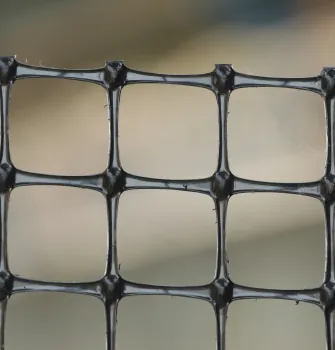
2. TechGrid PP Biaxial Geogrid (Reinforcement Layer)

  • Installation: Placed over the nonwoven geotextile, immediately below the ballast
  • Material: Polypropylene (PP) biaxial geogrid with high junction efficiency
  • Functions:
  • Reinforcement: Provides tensile strength to distribute train loads over a wider area
  • Lateral restraint: Confines ballast particles, preventing lateral spreading under dynamic loads
  • Settlement control: Minimizes differential settlements caused by weak or variable subgrade conditions
  • Crack bridging: Spans across shrinkage cracks, preventing their propagation into the ballast layer

Construction Approach:

  • Formation preparation: Existing surface leveled, compacted, and cracks filled
  • Geotextile laying: TechGeo Nonwoven Geotextile deployed over the formation
  • Geogrid installation: TechGrid PP Biaxial Geogrid placed over the geotextile with proper overlap
  • Ballast placement: Conventional ballast laid and compacted over the geosynthetic layers
  • Track restoration: Rails and sleepers reinstalled with precise geometry alignment

Key Advantages:

  • Cost efficiency: Eliminates need for thick granular blanket layers and imported fill material
  • Fast installation: Lightweight geosynthetics enable rapid deployment with minimal equipment
  • Performance enhancement: Improves formation bearing capacity and reduces track maintenance frequency
  • Durability: PP materials offer excellent resistance to chemical and biological degradation
  • Sustainability: Reduces quarrying, transportation, and associated carbon emissions

Project Outcome & Performance

  • The project was successfully completed for the 6.00 km stretch at Chavaj
  • Client satisfaction: Western Railways expressed appreciation for:
  • Product quality and technical performance of TechGrid PP Biaxial Geogrid and TechGeo Nonwoven Geotextile
  • Timely supply of materials as per project schedule
  • On-site technical support provided by the TechFab team during installation
  • Post-commissioning performance:
  • Reduced formation cracking and track settlement
  • Improved cross-level stability during monsoon seasons
  • Lower maintenance frequency and associated operational costs

This project demonstrates the effectiveness of geosynthetic reinforcement as a sustainable alternative to conventional blanket layer rehabilitation for railway formation stabilization.

Related Sectors
Related Solutions

Frequently Asked Questions
(FAQs)

It is a formation rehabilitation and ballast stabilization initiative on the Western Railway network at Chavaj, near Bharuch, Gujarat, on the busy Vadodara–Mumbai corridor. The project covered a 6.00 km stretch where highly shrinkable soils were causing summer cracking, monsoon-induced swelling, and track geometry distortions. The solution employed a dual-layer geosynthetic system—TechGrid PP Biaxial Geogrid and TechGeo PP Nonwoven Geotextile—installed just below the ballast to enhance bearing capacity and reduce maintenance. The client is Western Railways.

The Chavaj section exhibited a combination of geotechnical and operational challenges:

  • Highly shrinkable formation soil: Desiccation during summer caused shrinkage cracks that propagated into the ballast, leading to settlement and alignment loss
  • Monsoon vulnerability: Rainwater infiltrated through cracks, triggering soil swelling, cross-level variations, and track distortion
  • Increased axle loads and traffic density (GMT): Exceeded the bearing capacity of the existing formation, accelerating distress
  • Conventional rehabilitation constraints: Importing good-quality granular fill for a thick blanket layer was uneconomical and logistically difficult due to material scarcity and only shallow-depth weakness

Without intervention, these issues would result in repeated track renewals, speed restrictions, and higher lifecycle costs.

A two-layer system was placed immediately below the ballast in the typical cross-section:

Layer 1 (Bottom): TechGeo PP Nonwoven Geotextile

  • Role: Separation, filtration, and protection
  • Prevents intermixing of ballast with formation soil, allows controlled drainage, and cushions the geogrid from sharp ballast edges

Layer 2 (Top): TechGrid PP Biaxial Geogrid

  • Role: Reinforcement and load distribution
  • Provides tensile strength, confines ballast laterally, bridges shrinkage cracks, and reduces differential settlements

This configuration strengthens the formation–ballast interface without requiring a thick granular blanket.

The biaxial geogrid enhances track bed behavior through multiple mechanisms:

  • Tensile reinforcement: Distributes dynamic train loads over a wider area, reducing stress on weak spots
  • Lateral restraint: Confines ballast particles, minimizing lateral spreading under repeated loading
  • Crack bridging: Spans across formation shrinkage cracks, preventing their propagation into the ballast
  • Settlement control: Limits differential settlements caused by variable subgrade stiffness or moisture changes
  • Stiffness enhancement: Increases the apparent modulus of the ballast–formation composite, improving ride quality and geometry retention

The nonwoven geotextile provides three critical functions:

  • Separation: Stops ballast aggregates from punching into and mixing with the fine-grained formation soil, preserving drainage and strength
  • Filtration: Permits pore water to drain while retaining fines, reducing hydrostatic pressure buildup during monsoons
  • Protection: Acts as a cushion between the formation and the geogrid, lowering puncture risk from angular ballast during placement and tamping

Together, these functions maintain the integrity and longevity of the reinforced layer.

The geosynthetic approach addressed key project constraints:

  • Material scarcity: Avoided dependence on scarce, high-quality fill required for thick blankets
  • Cost and logistics: Reduced transportation, handling, and placement costs associated with imported aggregates
  • Shallow weakness: Targeted only the affected shallow depth rather than over-designing with deep granular layers
  • Speed: Lightweight rolls enabled rapid installation with minimal equipment and track possession time
  • Sustainability: Lower quarrying and transportation emissions aligned with environmental goals

The construction sequence was optimized for minimal disruption:

  • Formation preparation: Surface leveled, compacted, and shrinkage cracks filled/sealed
  • Geotextile laying: TechGeo Nonwoven deployed over the formation with specified overlaps
  • Geogrid installation: TechGrid PP Biaxial placed over the geotextile, aligned with track centerline
  • Ballast placement: Conventional ballast spread and compacted over the geosynthetics
  • Track restoration: Sleepers and rails reinstalled with precise geometry; tamping carried out with care to avoid damaging layers

Geosynthetics’ light weight and roll format enabled quick deployment during short possession windows.

Post-commissioning observations on the 6.00 km Chavaj stretch indicated:
  • Reduced formation cracking: Geogrid bridging limited crack propagation into the ballast
  • Better monsoon performance: Improved drainage and separation reduced swelling-induced cross-level variations
  • Enhanced stability: Lower differential settlements and improved track geometry retention
  • Lower maintenance frequency: Fewer tamping cycles and ballast renewals, translating to reduced operational costs
  • Client satisfaction: Western Railways appreciated product quality, timely supply, and on-site technical support from TechFab
  • TechGrid PP Biaxial Geogrid – For reinforcement, lateral restraint, and crack bridging below ballast
  • TechGeo PP Nonwoven Geotextile – For separation, filtration, and protection at the formation–ballast interface